 My mentor in the kitchen Stephen Pedalino taught this one to me, back when we were both working at the Mountain Sky Guest Ranch in the 1980s. A transplant from Staten Island, he cooked at resorts and big hotels around the country before landing in Paradise Valley, north of Yellowstone Park. I learned most of the basics from him, and spent a lot of time with him in the Old Saloon down at Emigrant, Montana, which was the nearest town (a stop with the Saloon and the post office, and a few houses; there may have been a small church, but we never set foot in it). We cooked from dawn till dark, the two of us, for the first few years, and we cooked just about everything, from basic bbq and campfire steaks, to poached whole salmon in aspic on the buffet, and seven-course meals based on recipes from Escoffier. I also learned some traditional Italian dishes, traditional sauces and pastas from Steve’s Sicilian heritage. They are old school recipes, and what I like about them is their simplicity, and minimalist approach to ingredients. I try not to tinker with them too much, relying on the wisdom of generations. And so, on to pork neckbone ragu. This slow-cooked sauce involves braising a leftover cut of meat and just a few ingredients–a recipe that after three hours proves that less can be decidedly more. I made a batch today, and it turned out pretty well. It’s an easy recipe, but does take time, and there are a few tricks. It’s a good one to do on a Saturday, and I always make a lot, and freeze it in pints, for a quick dinner during the week.
Ingredients:
2-3 lbs pork neckbones (you could also do this with pork shoulder steaks, but the neck bone has more flavor)
4-5 carrots, peeled and diced
1 large/2 medium yellow onions, diced
7-8 cloves of garlic
4-5 large cans of diced or whole peeled tomatoes (or use frozen* or fresh: two gallon ziploc bags of tomatoes from my garden went into today’s version)
salt and pepper
1/2 teaspoon crushed red pepper (optional)
*I freeze tomatoes at the height of the harvest, coring them and putting in ziploc bags. It’s easy to take the skin off this way, too: just put the tomatoes in hot water, and the skins slip right off. It’s easy to chop them when they’re frozen, and easy to puree them when they’re thawed, which you can do in the microwave, if you’re in a hurry.
 Begin by generously seasoning neck bones with salt and pepper. Put on sheet pan, and roast in 350 degree oven until well-browned. While bones are roasting, dice carrots, onion, and garlic. Season with salt and pepper and saute carrots and onions in olive oil on medium heat for 8-10 minutes in heavy saute pan, or until onions are translucent, then add garlic, and saute for another 2-3 minutes, stirring well. If using frozen or fresh tomatoes, peel, and chop or pulse in blender (do the same with canned whole tomatoes). Put browned bones, vegetables, and tomatoes in large dutch oven or soup pot, add water if it seems too thick, and bring to simmer, season with salt and pepper, and add crushed red pepper. Simmer for 3-4 hours, stirring often, adding liquid (you could use chicken stock for a richer sauce) if it gets too thick. When the meat is falling off the bone, remove bones, and cool (I put mine in a stainless steel bowl and put it out in the snow in the winter). When cool enough to handle, remove all the meat from the bones, taking care to remove gristle and small pieces of bone. It’s messy, but best to use your hands. Return meat to sauce, and simmer another 10 minutes or so, and season if necessary. Serve with a heavier pasta. I used perciatelli, and have also used bucatini, penne, rigatoni. Go easy on the sauce; it’s rich, and you don’t need a lot. Top with grated or shredded Parmigiano reggiano (if you have it), pecorino, or romano. This is a good one for feeding a crowd (I think I’ve used it to feed the high school swim team).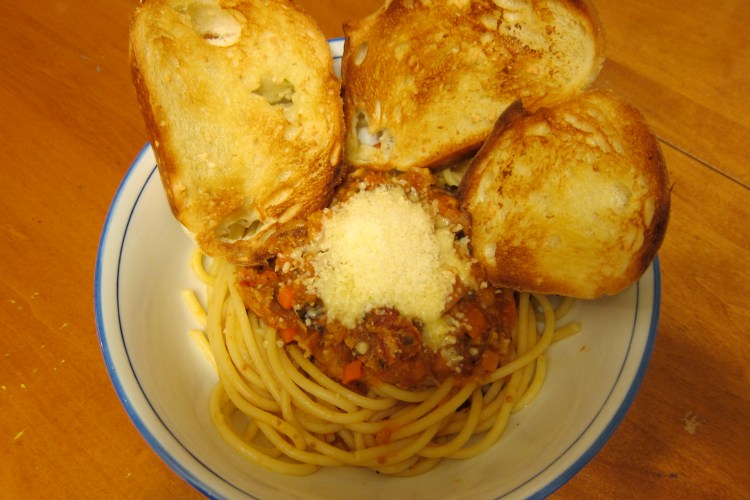

 FoodIowa