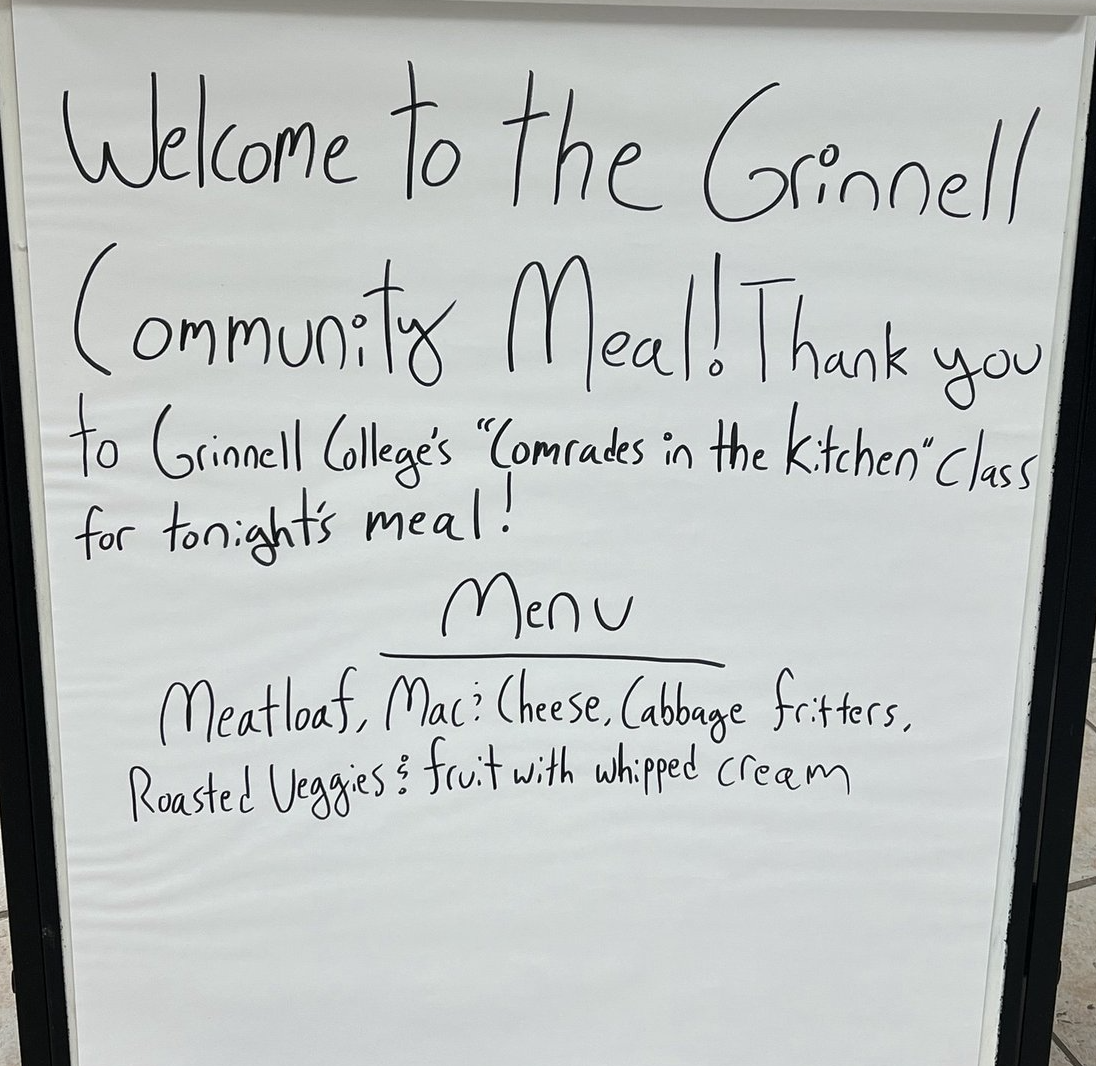
One of my heroes is José Andrés, founder of World Central Kitchen. It’s one of the charities I support and I’ve often contemplated taking time off to go volunteer (never more so than when Russia invaded Ukraine in February of 2022). Their work has inspired me, and I recently bought their cookbook: The World Central Kitchen Cookbook: Feeding Humanity, Feeding Hope. The recipes there are always for great quantities, as one might expect, and so is this one for meatloaf: my students and I made it for a Community Meal a few weeks ago in Grinnell College’s Marcus Family Global Kitchen, and from all accounts (my own included), it was really delicious. There are some underlying principles to the dish: 1) it should taste good and be enjoyed by children and adults alike 2) it should be (subtly) nutritious (people are surprised to hear how many vegetables are in it); 3) it should be open to variation and interpretation, depending on what ingredients are available; 4) it should be easy to prepare and serve; and 5) it should be economical.
I should add that this recipe is inspired by a dish from the former Soviet Union: котлеты [kotlety], a word that sounds like “cutlets,” but is essentially a meat patty made using lots of fillers. The meat patty recipe is one that evolved from the recipe for American hamburgers, as imported by Anastas Mikoyan, the USSR foreign trade minister who toured US food production facilities in the 1930s. He purchased something like 35 hamburger grills, seeing in the dish a convenient way for workers to get a bite to eat. Meat was often in short supply, however, especially during the war years, and in order to stretch the recipe, various fillers were added–much like US meatloaf recipes. The bun also disappeared somewhere along the way, and kotlety essentially became a meat course, served alongside mashed potatoes, buckwheat, or other starch. (Sandwiches, or бутерброды/buterbrody, are always open-faced in this part of the world, and I’ve even seen Russians remove the top bun when eating a hamburger. )
The added vegetables in this recipe, beyond stretching it, make for a moist meatloaf and blend well with the meat. I’m particularly fond of the addition of carrots, which add a sweetness to the dish. You could also make kotley from this recipe by forming the mixture into oval patties, dredge in seasoned bread crumbs, and fry or bake.
This recipe served 60-65 people, and was accompanied by mac and cheese and roasted vegetables.
Ingredients
Sauce
1 16 oz can tomato paste
1 16 oz bottle of ketchup
1 teaspoon Worcestershire sauce
1/2 cup brown sugar
1 1/2 cups water
1/2 teaspoon salt
1/2 teaspoon pepper
Meatloaf
10 pounds ground beef (could also be a 4/6 mix of pork and beef)
3 pounds yellow onions, finely diced
2-3 large leeks, finely diced*
2 pounds carrots, shredded
2 pounds zucchini, shredded
2-3 pounds mushrooms (champignon or baby portabella), finely chopped
1 bunch parsley, finely chopped
2 bulbs garlic, finely minced
1/2 cup dried minced onions
3-4 cups breadcrumbs
4 eggs
olive oil for sautéing vegetables
salt and pepper
*Leeks often have sand in between their layers and need to be cleaned carefully. Once you have finely diced them, put in bowl with water and soak to remove sand and grit. Lift leeks out of water with a strainer, empty bowl, and repeat process. If you don’t have leeks, add 2 more onions.
Recipe
For the sauce, combine ingredients, add 1 cup water, and simmer until thickened. Adjust seasonings, and reserve.
For the meatloaf:
1) Place ground beef in large bowl.
2) Sauté vegetables: the onions, leeks, and carrots in olive oil in one pan, and the zucchini and mushrooms in another, also in olive oil, over medium-high heat, seasoning liberally with salt and pepper and stirring frequently until cooked through–almost to the point of browning. Add the minced garlic to onions, leeks, and carrots, and cook another minute. Let cool. Sauté the zucchini and mushrooms until most of the liquid has evaporated. Set aside to cool.
3) Combine meat, parsley, eggs, and half the breadcrumbs, and begin to mix. Add 2 teaspoons of salt and 1 teaspoon finely ground black pepper. Add cooled vegetables and incorporate thoroughly. If the mix is too loose and/or moist, add breadcrumbs until it holds together well. To check seasoning, cook off a small portion to taste. Add seasoning as needed, and then form into large loaves in hotel pans or casserole dishes.
4) Bake at 350 degrees until meat thermometer reads 145 degrees, pour tomato-ketchup sauce over top, return to oven, and bake until internal temp is 160. The sauce should form a kind of glaze. Since there’s a lot of sugar in the tomatoes and ketchup, in a hot oven the top may brown quickly, so check often, and loosely cover with foil if starts to burn before the meat has reached temperature. Once done, remove from oven, cover loosely and let rest about 15 minutes, which will make it easier to slice.
5) Slice in 3/4 inch-1 inch slices, and serve with remaining tomato-ketchup sauce. We served this dish with mac and cheese; it goes well with mashed potatoes, too.
Enjoy!

 FoodIowa
One thought